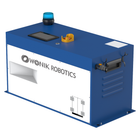
- Built for 24 V / 50 Ah Li-ion packs The station is specified for lithium-ion battery packs rated DC 24 V with a 50 Ah capacity, the class carried by Wonik Robotics' own mobile robots.
- About 1 to 1.5 hours per cycle The charging window is approximate, so the real figure moves with the pack's starting state of charge and its condition.
- Automatic charging A robot can start a charge without anyone present, which is what lets a platform top itself up between task assignments on a recurring route.
- Manual charging An operator can also start a charge by hand, which suits maintenance, bench testing and any workflow where staff already handle the robot between runs.
- A fixed point in the route The station is the supply side of the pair: the pack stays on the robot, and this is where energy is put back into it between runs.
- Specified by pack class, not by robot Suitability comes down to whether a platform carries the supported pack, so compatibility with a particular robot is worth settling before an order rather than assumed.

Description
The Charging Station is the companion piece to Wonik Robotics' autonomous mobile robots: the fixed point in a facility where a platform puts energy back into its battery. It is specified for lithium-ion packs rated DC 24 V with a 50 Ah capacity, takes about 1 to 1.5 hours over a cycle, and accepts a charge started either automatically or by an operator.
Read the battery rating as describing the pack being charged, not a battery inside the station. The pack lives on the robot; this is the supply-side device. That also frames compatibility: the station is defined by the pack class it serves rather than as a general-purpose charger, so whether it suits a particular platform depends on the pack that platform carries.
Having both charging methods is what shapes the operation around it. An automatic charge lets a robot top up between task assignments with nobody involved, which fits logistics and warehouse work on recurring routes and production floors where material transport runs alongside a line. A manual start is useful during maintenance or bench testing, and in workflows where staff already handle the robot between runs.
Three figures are specified for this unit: the pack class, the approximate charging window and the two charging methods. Input supply, output current, dimensions, weight, enclosure construction, operating temperature range, mounting and the docking procedure are confirmed at quote. Treat the 1 to 1.5 hours as an indicative window rather than a fixed value, and do not extend it to packs of other voltages or capacities.
Key Capabilities
- Built for 24 V / 50 Ah Li-ion packs: The station is specified for lithium-ion battery packs rated DC 24 V with a 50 Ah capacity, the class carried by Wonik Robotics' own mobile robots.
- About 1 to 1.5 hours per cycle: The charging window is approximate, so the real figure moves with the pack's starting state of charge and its condition.
- Automatic charging: A robot can start a charge without anyone present, which is what lets a platform top itself up between task assignments on a recurring route.
- Manual charging: An operator can also start a charge by hand, which suits maintenance, bench testing and any workflow where staff already handle the robot between runs.
- A fixed point in the route: The station is the supply side of the pair: the pack stays on the robot, and this is where energy is put back into it between runs.
- Specified by pack class, not by robot: Suitability comes down to whether a platform carries the supported pack, so compatibility with a particular robot is worth settling before an order rather than assumed.
This model is offered on a quotation basis. Configuration, accessories, integration scope and delivery schedule all change the final figure, so pricing is confirmed per project rather than listed.
Buying through Robotix Market
This unit is sourced new through established distribution channels and ships worldwide with the manufacturer warranty. Technical support is coordinated with the manufacturer's own service network. Deployment scope, configuration, and commissioning responsibilities are agreed as part of the quotation — on-site installation is not included in the product price.
Features
Specs
| Brand | Wonik Robotics |
|---|---|
| Manufacturer | Wonik Robotics, South Korea |
| Model | Charging Station |
| Product Type | Charging station for autonomous mobile robot battery packs |
| Supported Battery Type and Capacity | Li-ion, DC 24 V / 50 Ah |
| Charging Time | About 1 to 1.5 hours (approximate) |
| Charging Method | Automatic / Manual |
| Product Range | Wonik Robotics autonomous mobile robot (AMR) line-up |
| Input Supply Requirement | Confirm at quote |
| Output Current | Confirm at quote |
| Dimensions | Confirm at quote |
| Weight | Confirm at quote |
| Enclosure Construction | Confirm at quote |
| Operating Temperature Range | Confirm at quote |
| Mounting Arrangement | Confirm at quote |
| Docking or Connection Method | Confirm at quote |
| Compatible Robot Models | Confirm at quote |
| Battery Pack Included | Confirm at quote |
Industries
Frequently Asked Questions
It is offered by quotation — configuration, quantity and delivery are confirmed per project.
Lithium-ion packs rated DC 24 V / 50 Ah. That rating describes the pack being charged rather than a battery inside the station, and packs of other chemistries, voltages or capacities are not covered by the specification.
About 1 to 1.5 hours for the supported 24 V / 50 Ah pack, and the figure is an approximate one. Real durations move with the pack's starting state of charge and its condition, so plan around the window rather than a fixed number.
An automatic charge is started without an operator, which suits a robot topping up between task assignments, while a manual charge is started by a person. Both are supported; the docking and connection procedure behind each is confirmed with the quotation.
Compatibility with other manufacturers' robots is confirmed with the quotation. The station is defined by the pack class it serves, so whether it suits a particular robot or pack is something to settle with the quotation rather than assume.
The electrical and mechanical detail. Input supply, output current, dimensions, weight, enclosure construction, operating temperature range and mounting arrangement are confirmed at quote.
Recently Viewed
You haven't viewed any products yet.