- Two driven axes for the head Pan and tilt let the G1 aim its sensor independently of the torso, so it can track a subject while the body stays put.
- Intel RealSense D455 depth camera The wide-baseline member of Intel's D400 family is supplied with this module.
- 95 mm stereo baseline Roughly twice the D435's baseline, which is what keeps depth error low at useful working distances.
- 0.6 to 6 m depth range The operating range is about 0.6 to 6 m with an 86° × 57° depth field of view, covering arm's length to room scale.
- Global-shutter RGB and an IMU A 1280 × 800 global-shutter colour sensor and an onboard inertial measurement unit come on the camera, over USB-C.
- Camera model confirmed in writing The G1's standard head carries a D435i, so we confirm the camera supplied with this module before the order.

Description
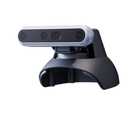
This is the two-degree-of-freedom head module for the Unitree G1 humanoid, supplied with an Intel RealSense D455 depth camera. Two driven axes let the robot pan and tilt its sensor independently of its torso — the difference between a camera that points wherever the body happens to face and one that can track a person, follow a hand or sweep a workspace while the robot stands still.
The D455 is the wide-baseline member of Intel's D400 family, and the baseline is the point: at 95 mm it is roughly twice the D435's, which is what keeps depth error low at useful working distances. It offers a depth field of view of 86° × 57° (±3°), an operating range of about 0.6 to 6 m, a global-shutter RGB sensor at 1280 × 800, an onboard IMU and a USB-C connection.
For a humanoid doing manipulation or human-robot interaction research, those two things together — steerable gaze and metric depth at arm's length to room scale — are what make grasp-pose estimation, gaze-directed attention and person tracking practical on the robot itself rather than from a fixed external camera.
One point needs settling in writing. The G1's standard head carries a RealSense D435i, while this module carries a D455, and G1 configurations differ widely in any case — from 23 to 43 degrees of freedom depending on options. Which G1 editions the module fits, how it mounts, its own dimensions and weight, and the cabling and software needed are all confirmed in writing before the order.
Key Capabilities
- Two driven axes for the head: Pan and tilt let the G1 aim its sensor independently of the torso, so it can track a subject while the body stays put.
- Intel RealSense D455 depth camera: The wide-baseline member of Intel's D400 family is supplied with this module.
- 95 mm stereo baseline: Roughly twice the D435's baseline, which is what keeps depth error low at useful working distances.
- 0.6 to 6 m depth range: The operating range is about 0.6 to 6 m with an 86° × 57° depth field of view, covering arm's length to room scale.
- Global-shutter RGB and an IMU: A 1280 × 800 global-shutter colour sensor and an onboard inertial measurement unit come on the camera, over USB-C.
- Camera model confirmed in writing: The G1's standard head carries a D435i, so we confirm the camera supplied with this module before the order.
Buying through Robotix Market
This unit is sourced new through established distribution channels and ships worldwide with the manufacturer warranty. Technical support is coordinated with the manufacturer's own service network. Deployment scope, configuration, and commissioning responsibilities are agreed as part of the quotation — on-site installation is not included in the product price.
Features
Specs
| Brand | Unitree Robotics |
|---|---|
| Model | G1-Head dual-degree-of-freedom module |
| Product type | Head and neck module with depth camera (accessory) |
| Compatible with | Unitree G1 humanoid robot — confirm the edition at quote |
| Degrees of freedom | 2 (pan and tilt) |
| Depth camera supplied | Intel RealSense D455 |
| Camera depth technology | Stereo depth with an infrared projector |
| Camera depth field of view | 86° × 57° (±3°), per Intel |
| Camera operating range | About 0.6 to 6 m, per Intel |
| Camera stereo baseline | 95 mm |
| Camera RGB sensor | 1280 × 800 global shutter |
| Camera IMU | Included |
| Camera connection | USB-C |
| Joint torque and range of motion | Confirm at quote |
| Module dimensions and weight | Confirm at quote |
| Mounting, cabling and software | Confirm at quote |
| Camera model in the standard G1 head | RealSense D435i; confirm at quote |
Industries
Frequently Asked Questions
It gives the G1 two driven head axes, pan and tilt, so the robot can aim its depth camera independently of its torso and track a person, a hand or a workspace while standing still.
An Intel RealSense D455. The G1's standard head carries a D435i, so we confirm the camera for this module in writing before the order.
It has a depth field of view of 86° × 57° with a tolerance of ±3°, an operating range of about 0.6 to 6 m, a 95 mm stereo baseline and a 1280 × 800 global-shutter colour sensor, with an onboard IMU over USB-C.
A wider baseline keeps depth error lower at a given distance. At 95 mm the D455's is roughly twice the D435's, which is what makes it the choice for manipulation and interaction work at room scale.
G1 configurations vary widely, so which editions the module fits and how it mounts are confirmed against your specific unit before the order.
The Unitree G1 Dual-DOF Head Module with RealSense D455 is priced at £2,980 in your market.
Unitree G1 Dual-DOF Head Module with RealSense D455
- Regular price
- £2,980.00
- Sale price
Recently Viewed
You haven't viewed any products yet.